
Nebraska Public Records Act Framework
The Nebraska Public Records Act is the law that sets the floor for access to county and state government files. The core right sits in Neb. Rev. Stat. § 84-712, which lets any citizen of the state inspect and make copies of public records during office hours. Inspection itself is free. Copies, staff time, and technology services may carry a fee that the agency must set in a published schedule. The broad definition of a public record sits in § 84-712.01, which covers files regardless of physical form, including paper, microfilm, electronic media, and audio or video.
Who has to respond? Any state or local public body that holds a covered file. That includes the Lancaster County Clerk, the Lancaster County Board, the Lancaster County Treasurer, the Sheriff for non-investigatory files, and the County Assessor. Court files are also public, but they run through the Clerk of the District Court and the Lancaster County Court under a separate court records search policy from the Nebraska Judicial Branch. The statute applies to records, not to questions; an agency does not have to create a new record to answer a research query.
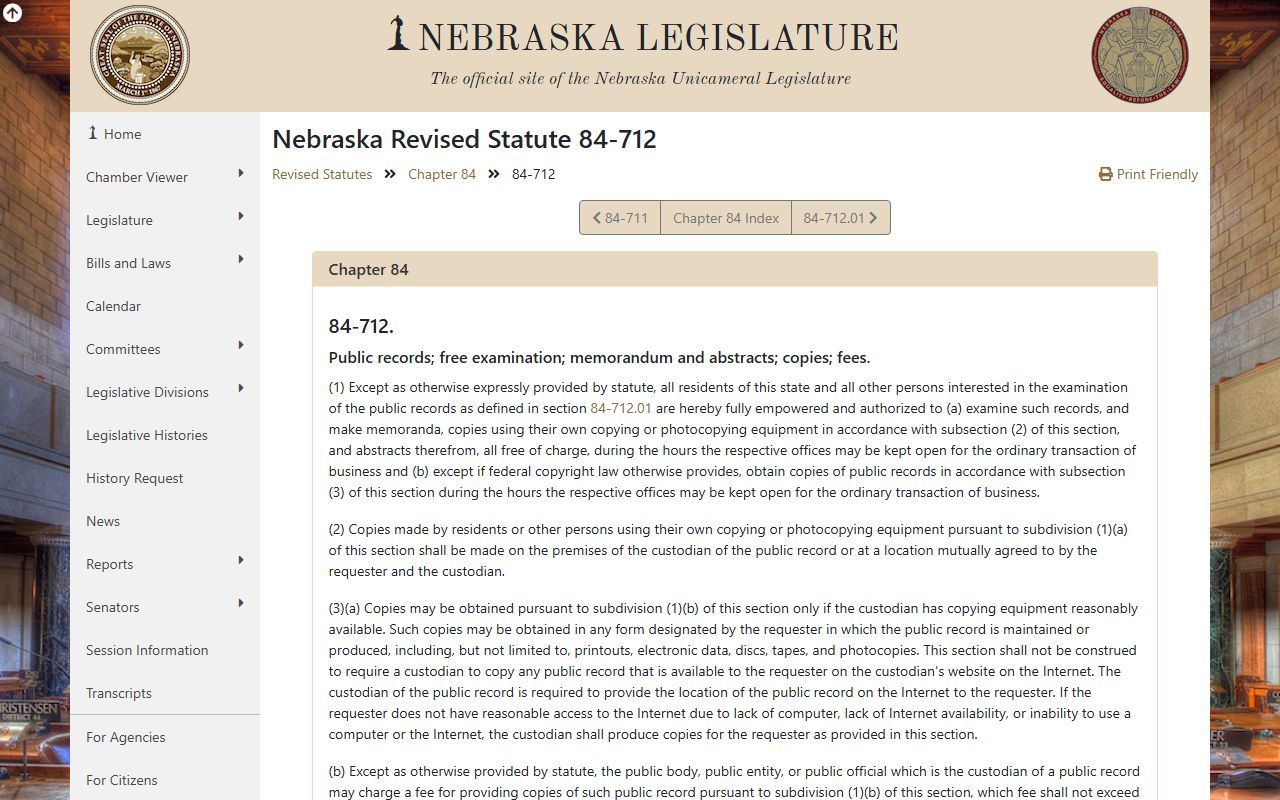
Section 84-712 confirms the basic right to inspect any non-restricted public record during regular office hours at no charge for the look itself.
How to File a Lancaster County Public Records Request
The county does not require a special form for most requests, but a clear written request moves faster than a vague one. The Lancaster County Clerk takes requests by email, by mail, or in person at Room 108 of the County-City Building. The clerk will only respond for records the office actually holds. A request for County Court or District Court case files needs to go to the right court clerk instead, since the County Clerk does not maintain court case records or files for other county or city departments.
- Identify the right office. Match the record to its keeper. Marriage records since mid-June 1976, county board agendas, minutes, resolutions, contracts, and county fiscal files go to the Lancaster County Clerk. Court case files go to the Clerk of the District Court at 402-441-7328 or the Lancaster County Court at 402-441-7291. Property deeds and real estate filings go to the Register of Deeds. Older marriage records from 1909 to mid-June 1976 go to Nebraska DHHS Vital Records.
- Write the request in clear terms. Name the type of record, the date or date range, the parties or subject, and the format you want. A short list works better than a long story. Vague phrasing like "all records about X" forces the clerk to ask follow-ups and can slow the response.
- Submit the request. Email to coclerk@lancaster.ne.gov, mail to Lancaster County Clerk, 555 South 10th Street, Room 108, Lincoln NE 68508, or drop it off in person at Room 108. The county notes that emailed request forms for certified marriage copies are not accepted; those need mail or in-person delivery with a photo ID copy. General records requests can use email.
- Wait for the response. Nebraska law expects a prompt reply. The clerk will confirm what is available, set a copy or staff time fee where one applies, and explain any redactions or withholdings. Routine requests for short files often turn around the same week.
- Pay any fees and pick up the records. Pay by check, card, or cash per the office terms. A credit or debit service fee of $1.25 or 2.35 percent, whichever is greater, applies on card payments. Records can be picked up at Room 108, mailed, or delivered on a flash drive at the cost of the device.
Public Records Request Form Fields
A Lancaster County public records request does not need a custom form for most non-court files. The fields below match what the County Clerk asks for in a written request or what the office needs in order to find and copy the record. The certified marriage copy form does have its own field set, listed below the general request table. Plan the request before you send it so the clerk does not have to come back for missing detail.
| Field | Required | Notes |
|---|---|---|
| Requester name | Yes | First and last name of the person making the request. |
| Mailing address | Yes for mailed reply | Full return address for mailed copies. |
| Phone or email | Recommended | For clarification questions and fee quotes. |
| Description of records | Yes | Type of file, parties or subject, date or date range. |
| Format preference | No | Paper, email, or flash drive at cost of device. |
| Reason for request | No | Not required under the Public Records Act. |
| Delivery method | Yes | Pick up at Room 108, mail, or electronic. |
| Signature and date | Yes if printed | Confirms the request and request date. |
The certified marriage record request form, posted by the county at the Document Center, adds a few specific fields: both applicants’ full names including maiden names, date of marriage, number of certified copies, payment fields, and a photo ID copy when mailed. Each certified copy is $9. The form is available online, by mail, or in person, but emailed forms are not accepted for marriage certified copies.
Fees for Lancaster County Public Records
Inspection during office hours is free. Costs kick in for copies, certified items, search time that runs long, electronic media, and IT extraction of data from county systems. The Lancaster County Clerk publishes a fee schedule that covers both record copies and licensing items. The table below pulls the most common items from the county pages.
| Service | Amount | Notes |
|---|---|---|
| Inspection at the office | Free | During regular hours; bring photo ID. |
| Certified marriage copy | $9 each | County Clerk certified copy form. |
| Marriage license fee | $25 | Per county schedule under Neb. Rev. Stat. § 33-110. |
| Copy or research services | $20 per hour after 4 hours | County Clerk fee schedule. |
| Research or data collection over 8 hours | Hourly staff rate | Set by the office. |
| IT extraction or data manipulation | IT staff rate | County Clerk request page. |
| Flash drive | Cost of device | For electronic delivery on media. |
| Miscellaneous filing | $10 first page; $6 each added page | County Clerk fee schedule. |
| Credit or debit service fee | $1.25 or 2.35%, whichever is greater | Applies to card payments. |
Court file copy fees are different. A JUSTICE One-Time Search through the Nebraska Judicial Branch costs $17 per name search and applies whether the search returns a case or not. Subscriber detail views are $2 each. Those court fees do not run through the County Clerk and do not appear on the county fee schedule.
What Records Are Public
The County Clerk maintains a distinct set of records that are open under the Public Records Act. The clerk also confirms what the office does not hold, which saves time for anyone aiming a request at the wrong door. The list below covers the main categories that the County Clerk page identifies as records the office keeps.
- Marriage records since mid-June 1976, including certified copies on request.
- County Board agendas, minutes, resolutions, declarations, and proclamations covering board actions.
- County contracts entered into by the county on behalf of the public.
- Liquor, tobacco, and locksmith licenses issued or processed by the clerk.
- Property valuation protest records filed through the clerk.
- County fiscal, accounting, and payroll records held by the Records, Accounting, and Payroll divisions of the County Clerk’s office.
Other public records sit with other county offices. Deeds and real-property filings go to the Register of Deeds. Tax statements and payment history sit with the Lancaster County Treasurer. Assessment files sit with the County Assessor. Court case files of every type sit with the trial-court clerks at the Justice and Law Enforcement Center. Sheriff’s incident records may be partly public and partly investigatory; see the booking-side detail at arrest records.
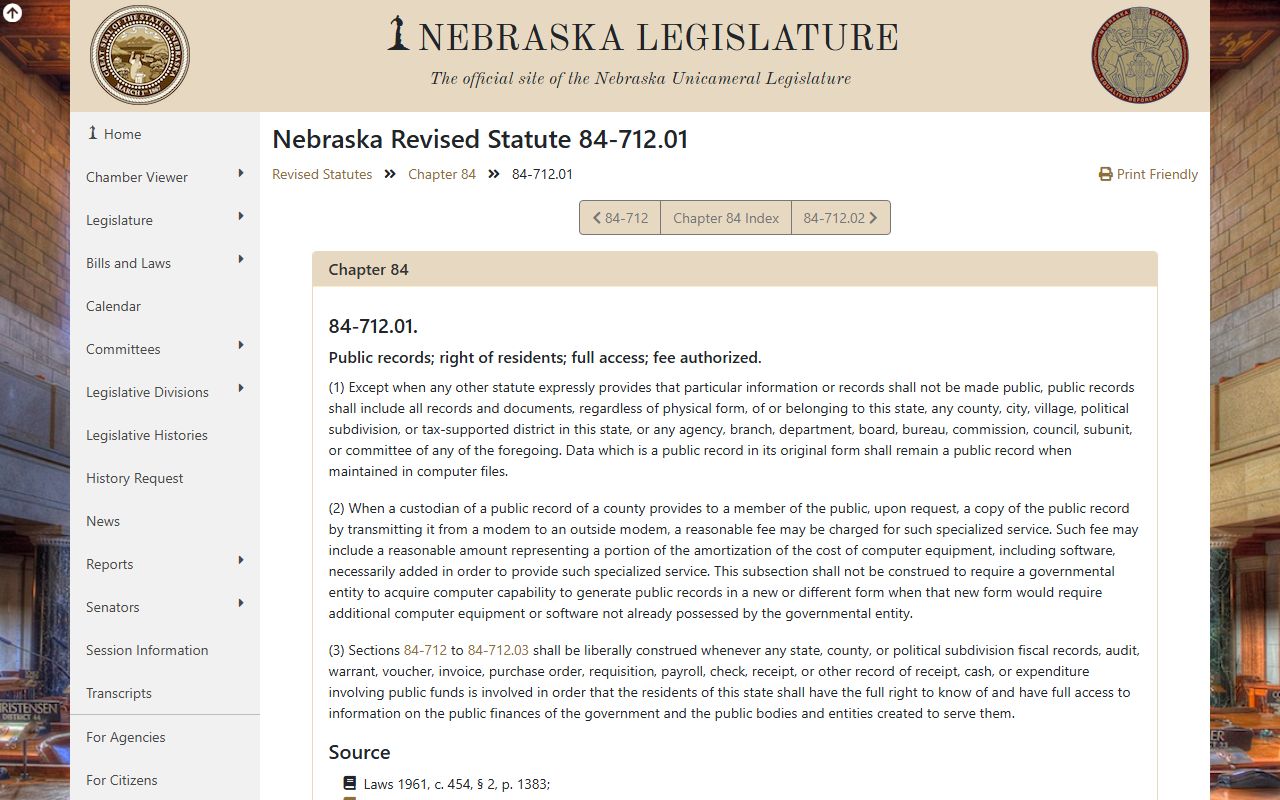
Section 84-712.01 sets the broad definition of a public record, which covers files in any physical form held by a public body.
Exemptions Under § 84-712.05
The Public Records Act sets a default of open access, but § 84-712.05 carves out classes of records that a public body may withhold. These exemptions do not seal the whole file; they let the agency redact the protected parts and release the rest. A clerk can also point to other statutes that bar release of a specific item, such as juvenile court records or DMV personal data.
- Personal information in personnel files where release would be a clearly unwarranted invasion of privacy.
- Medical records and health-related material in custody of a public body.
- Investigatory records compiled for law enforcement purposes during an open case.
- Trade secrets and proprietary commercial information shared in confidence.
- Security plans, vulnerability assessments, and infrastructure security records held by public agencies.
- Attorney work product and material prepared for or by counsel in pending or threatened litigation.
- Records sealed by court order or restricted by another state or federal statute.
Several other statutes layer on top. Juvenile case files are restricted under the juvenile code. Set-aside conviction effects are set by § 29-2264 and the criminal history dissemination rules in § 29-3523. DMV driver records carry privacy protections under the Uniform Motor Vehicle Records Disclosure Act at § 60-2901 et seq. Vital record misuse rules sit at § 71-649; the county warns that deceptive use of a vital record is a felony.
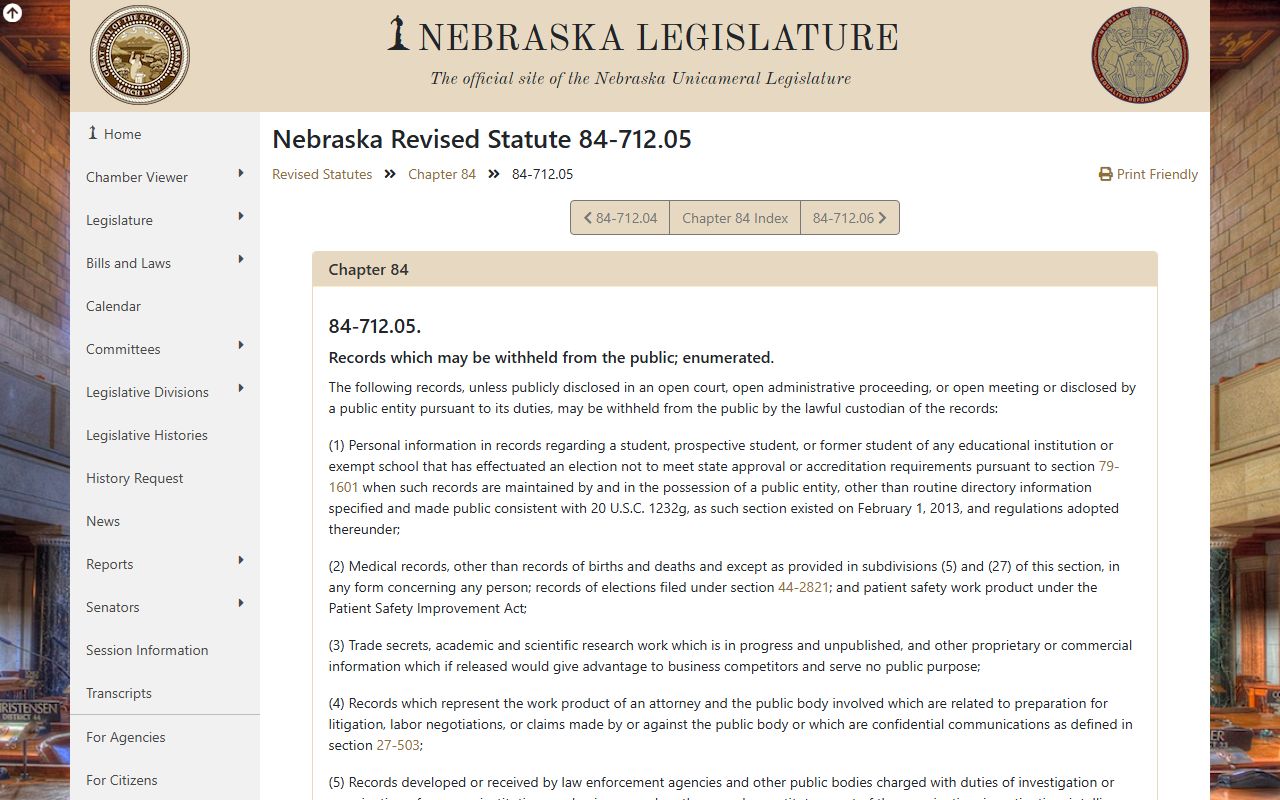
Section 84-712.05 lists the main exemption classes, including medical, investigatory, security, trade-secret, and personnel files.
Denials and § 84-712.03 Review
A denial is not the end of the road. If a county office turns down a request in whole or in part, the requester has the right to challenge that denial. Section 84-712.03 sets the review path. The office must issue a written denial that identifies the records withheld, the legal basis for withholding, and the official who made the call. The written denial duty itself comes from § 84-712.04 inside the same chapter.
From there the requester can ask the office to review the denial, or go straight to court. A writ of mandamus action in district court is the formal remedy when an agency refuses to produce a clearly public record. The court can order release and award costs and attorney fees where the law allows. The Nebraska Attorney General has also issued opinions on public records questions over the years, which can be cited as persuasive authority in a dispute.
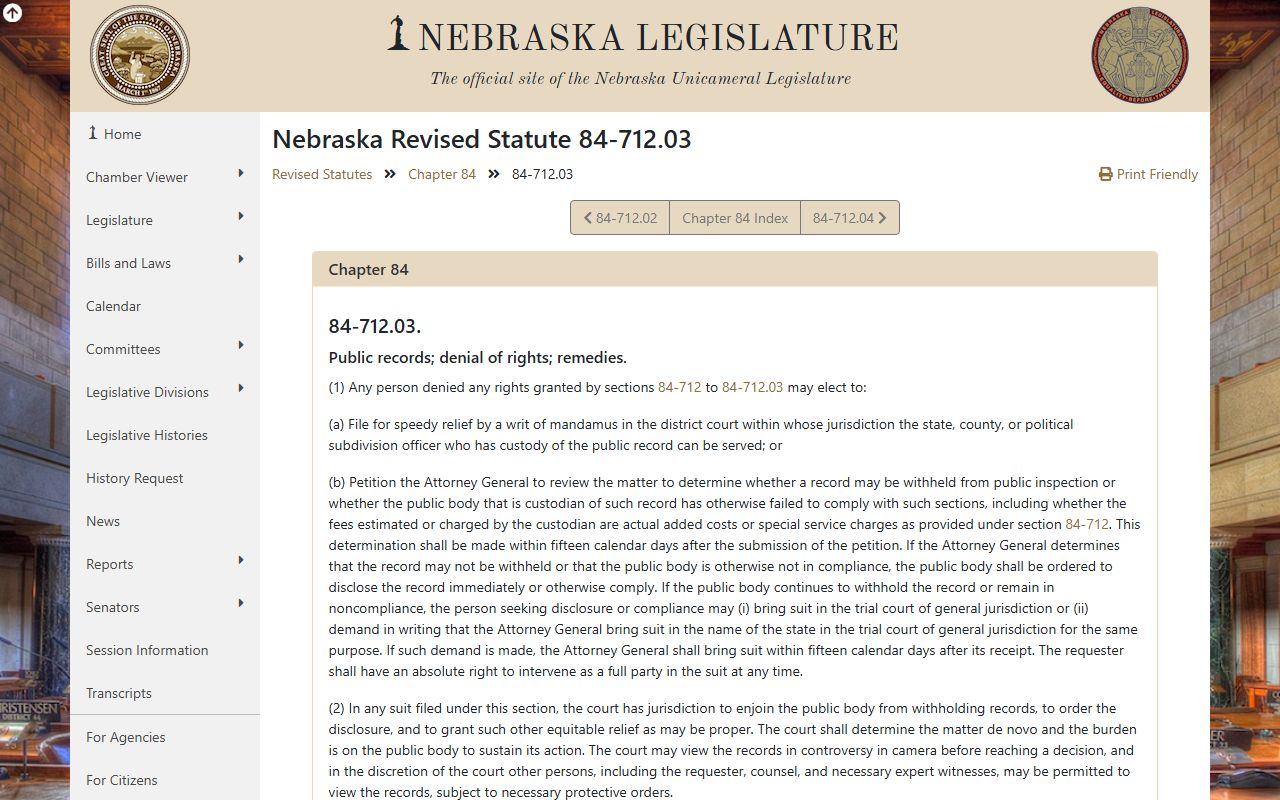
Section 84-712.03 gives the requester a clear route to challenge a denial through review and a mandamus action.
Court Records vs County Records
The single most common request error in Lancaster County is sending a court file question to the County Clerk. The County Clerk does not hold court case files. Court case files run through two clerks at 575 South 10th Street: the Clerk of the District Court for felony, civil over $70,000, equity, family law, and juvenile cases; and the Lancaster County Court clerk for misdemeanor, traffic, probate, small claims, and most municipal cases. Juvenile matters route to the Separate Juvenile Court on the fourth floor.
Court case files are searched through the Nebraska Judicial Branch JUSTICE system, not under the County Clerk request route. A one-time party-name search is $17. Free in-person access is at the courthouse and at Bennett Martin Public Library in downtown Lincoln. See court records for the full search workflow. The county records request page at lancaster.ne.gov also links both court request paths along with the County Clerk path, which can help a requester pick the right channel before sending the letter.
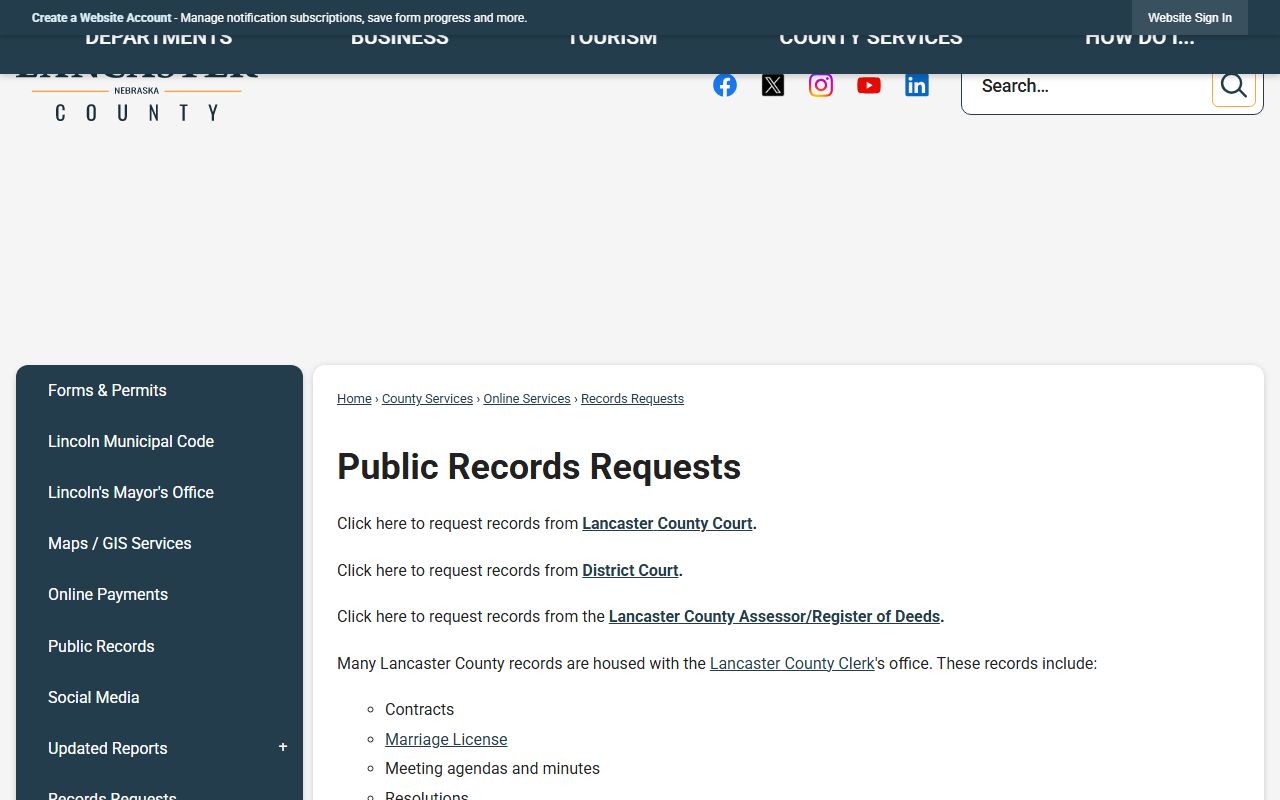
The county records request page lays out the County Court, District Court, and County Clerk routes side by side for a quicker pick.
Statewide Resources
The Nebraska Legislature posts the full text of the Public Records Act under Chapter 84. The index page lists every section of the act, including the inspection right, the records definition, the written denial duty, the review and mandamus remedy, and the exemption catalog. For complex denials, Attorney General opinions interpreting the act can be useful guidance, though they are advisory and not binding court rulings.
Court access policy is set separately by the Nebraska Supreme Court. The Nebraska Court Records Search Policy explains how JUSTICE terminal access, the one-time search, the subscriber service, governmental access, and the formal Public Records Act route all fit together for court files. Anyone preparing a large or sensitive court records request should read that policy first to set expectations on what the system returns and what it redacts.