
How to Search Lancaster County Probate Records
Lancaster County probate files sit inside the Nebraska Judicial Branch JUSTICE case management system. The same tool holds criminal, civil, traffic, juvenile, and probate cases from every county and district court in the state. The case information eServices page spells out the access tiers. A one-time party-name search costs $17 and returns up to 30 cases. A Nebraska.gov subscriber account is the better route for repeat use, with free general lists and $2 detail views. Free walk-in access is also available at the courthouse and at Bennett Martin Public Library in downtown Lincoln.
Before you run a Lancaster County probate records search, gather the decedent's full legal name, the rough year of death or filing, and the name of the personal representative if known. Probate cases use the PR prefix in JUSTICE. The court is the Lancaster County Court, not the District Court. A name search by decedent is the usual first pass; a name search by personal representative or by an heir works too when the decedent's name is too common.
The Judicial Branch search policy ties the JUSTICE terminal, the One-Time Search, the subscriber service, and the formal Public Records Act route together. Most users start with the one-time tool because it does not need any account setup. The Nebraska court records search policy sets the ground rules for what is public, what is restricted, and how fees apply to a probate search.
- Open the JUSTICE One-Time Court Case Search and check the terms-and-conditions box on the start page.
- Enter the decedent's last name first. Add a first name only if the name returns more than 30 matches.
- If you have subscriber access, narrow the court type to County Court, set the county to Lancaster, and set the case type to probate.
- Pay the $17 fee through the secure card form. The fee applies even when no record is returned.
- Review the case list, then click each case for the case detail, party list, financial ledger, register of actions, and document images.
- For older paper files, call the Lancaster County Court at 402-441-7291 and request a manual lookup.
Lancaster County Court Probate Jurisdiction
Probate is a limited-jurisdiction matter in Nebraska, and the Lancaster County Court is the court that holds it. The County Court statewide handles misdemeanors, traffic, municipal ordinances, probate, guardianship, conservatorship, adoption, small claims, and felony preliminary hearings. The Nebraska Judicial Branch lists Lancaster County Court at 575 South 10th Street with the main phone at 402-441-7291 and a separate civil and probate fax at 402-441-6055. Office hours are Monday through Friday, 8:00 a.m. to 4:30 p.m. The clerk is Melissa Ireland.
The County Court bench in Lancaster has seven sitting judges: Hon. Matthew L. Acton, Hon. Joseph E. Dalton, Hon. Holly J. Parsley, Hon. Timothy C. Phillips, Hon. Rodney D. Reuter, Hon. Ryan N. Decker, and Hon. Thomas E. Zimmerman. Any one of them can hear a probate matter, and case assignment depends on docket flow rather than a fixed probate division. The District Court does not hear probate. Adoption matters, even though they are heard in County Court, are confidential by statute and do not appear in a public probate search.
Types of Probate Cases
The probate jurisdiction of the Lancaster County Court covers a wide set of case types tied to death, incapacity, and the legal care of minors and adults. The same court handles a will that names heirs and an estate that opens because no will exists. The same court appoints a guardian for a minor child after a parent's death and appoints a conservator for an adult who can no longer manage money. Adoption files are also probate-track, but they are sealed.
- Testate estates. A decedent left a valid will. The court admits the will, names the executor, and oversees notice, inventory, claims, and distribution.
- Intestate estates. A decedent left no will. The court appoints a personal representative, and the assets pass under Nebraska intestate succession.
- Small estate affidavits. A short-form transfer under Neb. Rev. Stat. § 30-24,125 for personal property when the estate falls under the dollar limit set by statute.
- Guardianship. The court appoints a guardian to care for a minor or for an adult who cannot make personal decisions.
- Conservatorship. The court appoints a conservator to manage the property and finances of a minor or an adult who cannot manage money.
- Adoption. County Court hears adoption matters. Adoption records are confidential and do not appear in a public probate search.
- Determination of heirship and informal probate. Procedural tracks built into the Nebraska Probate Code.
Probate Process in Lancaster County
Opening an estate in Lancaster County follows a fixed path. The steps below sit inside the probate jurisdiction of the Lancaster County Court and apply to most testate and intestate estates. Some steps drop out for a small estate affidavit, and a few extra steps are added when a guardianship or conservatorship is part of the case.
- Decide whether probate is needed. A small estate affidavit under § 30-24,125 may move personal property without a full probate. Real estate and larger asset pools usually need full probate.
- Gather core papers. Locate the original will, the death certificate, a list of assets and debts, the names and addresses of heirs, and a list of known creditors.
- File the application or petition. Open the case in the Lancaster County Court at 575 South 10th Street. Pay the filing fee or ask for a fee waiver.
- Court appoints a personal representative. The judge issues letters of appointment that prove the personal representative's legal power to act for the estate.
- Give notice. Notice goes to heirs and devisees. Notice to creditors is also published, and proof of publication is filed.
- Inventory the assets. The personal representative lists all probate assets at their date-of-death value.
- Pay claims and taxes. Valid creditor claims are paid. Nebraska inheritance tax is handled at the county level. Federal estate tax applies only to larger estates.
- Distribute the estate. The personal representative transfers what is left to the heirs or devisees under the will or intestate rules.
- File the final report and close. A final accounting and a closing report go to the court, and the case closes.
The whole process can run a few months for a clean small estate or well over a year for a contested estate with real property and creditor disputes. A lawyer is not always required in Nebraska, but most personal representatives do hire one.
Common Probate Terms
Probate has its own vocabulary, and the same word can carry a slightly different meaning in different states. The short list below covers the core terms used in a Lancaster County probate file. Knowing these makes a JUSTICE register of actions much easier to read.
- Testator
- A person who made a valid will. A testator's estate is called testate.
- Executor / Personal Representative
- The person the court appoints to gather assets, pay debts, and distribute the estate. Nebraska uses the term personal representative for both will and no-will cases.
- Intestate
- A decedent who left no valid will. Property passes by Nebraska intestate succession rules rather than by a will.
- Guardianship
- A court order that gives one person the legal power to make personal decisions for a minor or for an adult who cannot decide for themselves.
- Conservatorship
- A court order that gives one person the legal power to manage the property and money of a minor or of an adult who cannot manage money.
- Letters
- The court paper that proves the personal representative, guardian, or conservator can act. Banks and title companies ask for letters before they release assets.
- Inventory
- A list of all probate assets at their date-of-death value.
- Accounting
- A report of what came in, what went out, and what is left in the estate or in the guardianship or conservatorship.
Probate Filing Fees in Lancaster County
Statewide filing fees for probate cases come from the Nebraska Supreme Court fee schedule. The current filing fees and court costs schedule took effect July 1, 2025 and applies to every Lancaster County probate filing. Copy fees, certification fees, and credit card service charges are added on top of the filing fee. Always confirm the live amount on the court page before you write the check.
| Filing | Where | Notes |
|---|---|---|
| Probate, guardianship, or conservatorship case | Lancaster County Court | Filing fee per the Nebraska Supreme Court schedule effective July 1, 2025. |
| Small estate affidavit | Held by the affiant; not always a court filing | Authority sits in § 30-24,125; statutory limit applies. |
| Adoption petition | Lancaster County Court | Filed under seal. Confidential by statute. |
| Inventory and accountings | Lancaster County Court | Filed during the life of the case. No new opening fee. |
| Letters of appointment | Lancaster County Court | Certified copy fee applies for each copy ordered. |
| Credit or debit card service fee | Court cashier | Card fee added on top of the filing fee. |
| JUSTICE One-Time Court Case Search | nebraska.gov | $17 per name; up to 30 cases; no-result fee still applies. |
| JUSTICE subscriber detail view | nebraska.gov subscriber account | $2 per detail view; general list searches are free. |
A litigant who cannot afford the filing fee may ask the court for a fee waiver. Probate cases that are run as informal probate, or that fall under the small estate threshold, may avoid the standard opening fee altogether. The clerk at the Lancaster County Court can walk a self-filer through the right form set.
Small Estate Affidavit Procedure
Not every Nebraska estate needs a full probate. A small estate affidavit under Neb. Rev. Stat. § 30-24,125 allows a successor to collect personal property of a decedent by sworn affidavit when the estate is below the limit set in the statute. The route saves time, saves money, and avoids opening a formal case in the Lancaster County Court for very small estates.
The statute applies to personal property only. Real estate cannot be transferred by a small estate affidavit. The affidavit must include the required statements about the decedent, the assets, the absence of a pending probate, and the right of the affiant to receive the property. A holder of the property, such as a bank, releases the asset to the affiant once the affidavit is presented.
The lead-in image below shows the official Nebraska Legislature page for the small estate affidavit statute, which is the source for the dollar limit and the required affidavit content. Always check the live statute for the current threshold, since the limit has been updated several times.
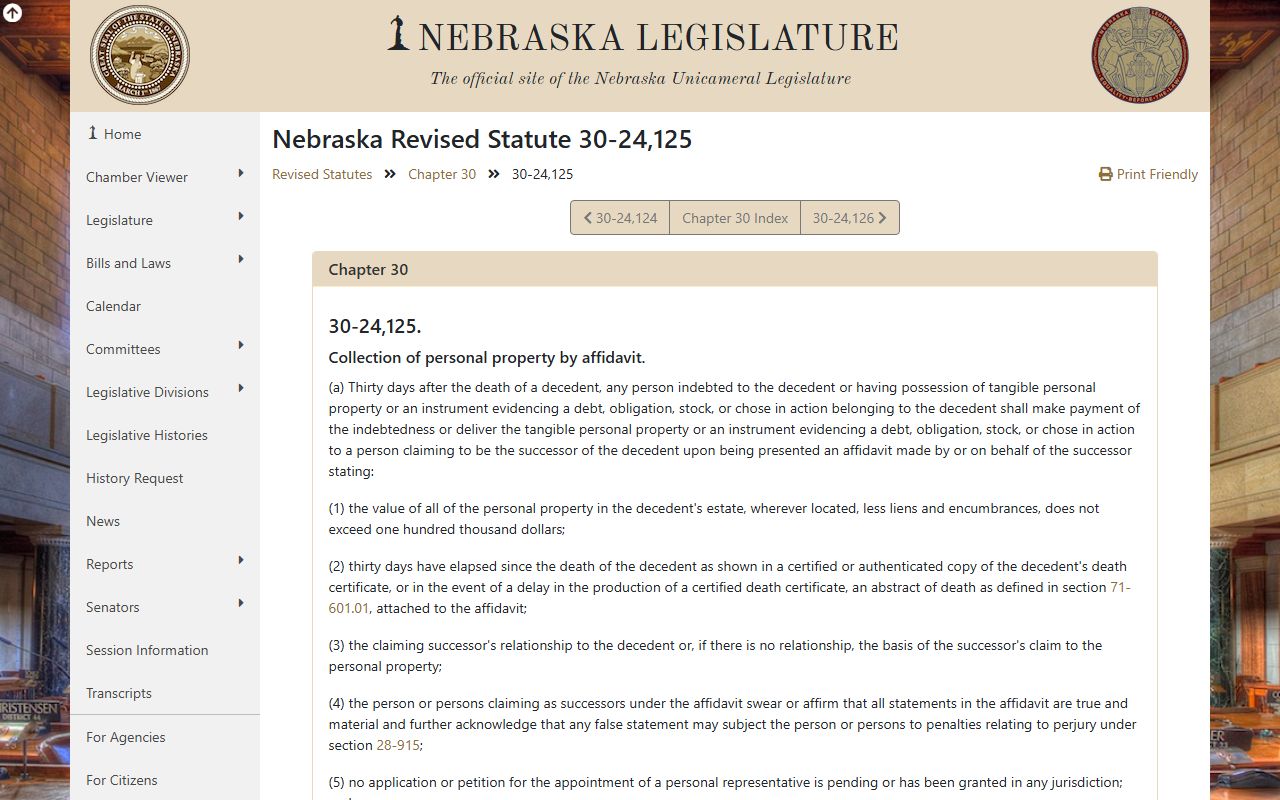
The statute is the legal anchor for the entire small estate process in Lancaster County and across Nebraska, so the affiant should pull the latest version before signing.
Restricted Probate Material
Most probate filings in Lancaster County are open to the public, but several classes of probate material are not. Adoption is the clearest example. Adoption files in Nebraska are confidential by statute and do not appear in a JUSTICE public search. A separate court order is required for any release of an adoption file, and even then most material stays sealed.
Guardianship cases that involve a minor child may carry sealing for some filings tied to the child's care. Medical and mental health material in an incompetency or conservatorship case is generally restricted under the same set of privacy rules that cover medical records elsewhere in court files. Protected identifiers such as Social Security numbers, bank account numbers, and minor children's full birthdates are redacted on public copies.
The broader public records framework sits in the Nebraska Public Records Act. Neb. Rev. Stat. § 84-712 sets the core right to inspect and copy public records during office hours. Section 84-712.05 sets the main exemptions, including medical, investigatory, and privacy carve-outs that often apply to material inside a probate file. For court-side restrictions, the Nebraska court records search policy controls.
Note: A Lancaster County probate records search inside JUSTICE returns only what the statute and court rules allow. Sealed, juvenile, and adoption material never appears in the public view, even when the case number is known.
Contact and Filing Locations
Probate filings, requests for certified copies, and walk-in record reviews all go through the Lancaster County Court. The County Court is on the third level of the Justice and Law Enforcement Center at 575 South 10th Street in Lincoln. Walk-in hours are Monday through Friday, 8:00 a.m. to 4:30 p.m. Bring a government photo ID, the case number when known, and payment for any copy fees.
Lancaster County Court (Probate)
Clerk Melissa Ireland
575 South 10th Street
Lincoln, NE 68508
402-441-7291
Civil and Probate Fax: 402-441-6055
Mon-Fri 8:00 a.m. - 4:30 p.m.
Clerk of the District Court
Simon G. Rezac
575 South 10th Street, 3rd Floor
Lincoln, NE 68508
402-441-7328
Mon-Fri 8:00 a.m. - 4:30 p.m.
Lancaster County Clerk
Matt Hansen
555 South 10th Street, Room 108
Lincoln, NE 68508
402-441-7481
Mon-Fri 7:30 a.m. - 4:30 p.m.
The District Court and the County Clerk do not hold probate case files. The District Court handles felonies, large civil cases, and most family law. The County Clerk handles marriage licenses, county board records, and county fiscal records. A probate question should go straight to the Lancaster County Court at 402-441-7291.